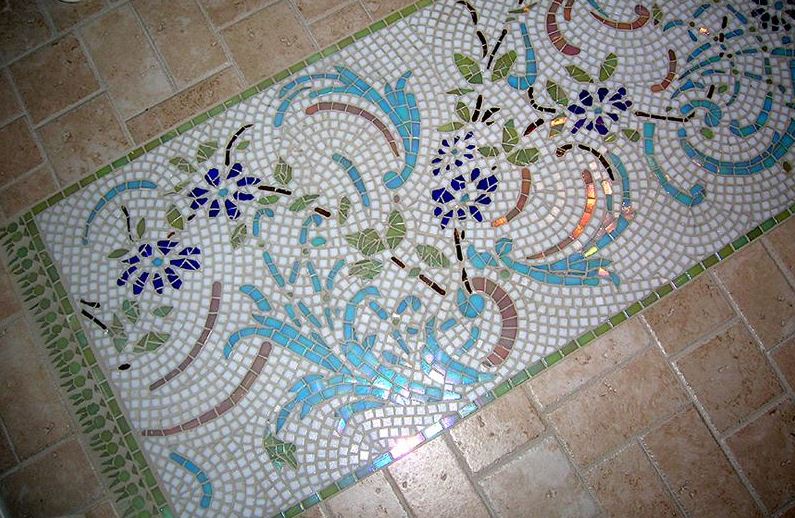
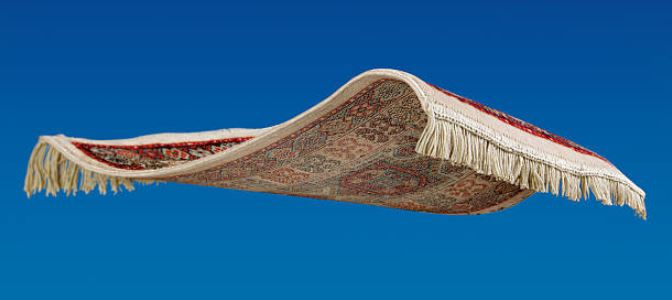
This photograph of a mosaic floor rug inspired me to think about literature in a new way: Once the tiles are in place, the mosaic need not merely sit on the wall. Rather, the reader can let the mosaic of literature carry her/him, akin to a magic carpet, away into the imagination.
All in all, I feel that this semester was eye-opening for me in terms of my creative writing. I feel confident about what I produced, because I can incorporate what I learned from peer-read-and-reviews about the importance of pacing, and the value of giving each character a unique voice, because I want my characters to be realistic; in real life, no two people speak in exactly the same way. I was also very privileged and am eternally grateful for the opportunity to read and review my classmates’ magnificent work. My goals for after class, particularly in terms of taking future writing classes and/or professionalizing my work in the future, involve making the world a better place, one book at a time. Since I understand that I can reach a greater number of people through the internet, I may plan to continue blogging. I’m more than happy to report that, thanks to my professor’s instruction and my classmates’ insight, I feel strongly that my literary toolbox is far fuller than it was back in September. My professor’s expert instruction opened eyes that I had not known were closed and inspired me to stretch my literary brain in new directions, letting me see what I and others write through novel—pardon the pun—lenses. Furthermore, this semester’s class has further opened my eyes to literature’s magic, and how, in the literature department, there truly is something for everybody; if somebody decides that s/he doesn’t like to read, perhaps s/he merely has not “met” the right books yet. Once one “meets” the right book, the book becomes a magic carpet that the reader need not budge from her/his comfy spot to mount. I am so grateful for the privilege of being a Stevenson University student, grateful for the Creative Writing course that I took this semester, grateful to my professor for her expert coaching, grateful to my classmates for posting their written work and constructive feedback on my written work. I will hopefully do my best to incorporate that feedback into my work, as well as spread literature’s magic by hopefully helping more people find their personal literary magic carpets.
I recently revisited Robert Frost’s The Road Not Taken, and my older eyes plumbed new depths intertwined among the lyrical iambic pentameter and wise, twinkly-eyed voice. “Two roads diverged in a yellow wood, [and] sorry I could not travel both […] I took the one less traveled by, [and] that has made all the difference.” (Foundation, 2020) Lloyd Alexander said that “Fantasy is hardly an escape from reality. It’s a way of understanding it,” (Lloyd Alexander Quotes, n.d.) and The Road Not Taken shines as proof of Alexander’s insight as brightly as autumn sunshine through yellowed leaves. Bustling through an ever-rushing world, a leisurely walk through arboreal gold may be the final thing on anybody’s mind, or at least anybody’s sunniest fantasy. Since literature, according to Lloyd Alexander, is meant to let us take a non-escapist break from external noise and armor us for life (Lloyd Alexander Quotes, n.d.), this “sunny fantasy” may be exactly what the public needs. The Road Not Taken sugarcoats nothing, instead taking a realistic approach to actions, consequences, and responsibility: “And be one traveler, long I stood[, and] looked down one as far as I could[, to] where it bent in the undergrowth. […] Yet knowing how way leads on to way, I doubted if I should ever come back. I shall be telling this with a sigh[, somewhere] ages […] hence: […] I took the one less traveled by, [and] that has made all the difference.” (Foundation, 2020) Simultaneously, The Road Not Taken imparts its fundamental lessons on actions, consequences, and responsibility with a steady beat akin to a living heart’s, yet The Road Not Taken’s longer stanzas resemble a slower, calmer beat, inviting the reader to relax and think. Furthermore, beyond the messages of actions, responsibility, and consequences, The Road Not Taken offers the reader courage to learn, try, or explore something new: “Then took the other, as just as fair, [and] having perhaps the better claim, [because] it was grassy and wanted wear; […] And both that morning equally lay [in] leaves no step had trodden black. […] I took the one less traveled by, [and] that has made all the difference.” (Foundation, 2020) Robert Frost’s The Road Not Taken is more than a literary feast for the mind; The Road Not Taken is a banquet for the spirit.
I recently read O. Henry’s A Retrieved Reformation, and, among other wonderful aspects of writing that this short story has to offer, I especially noticed the tongue-in-cheek humor acting as a veil for life lessons. Henry probably wrote A Retrieved Reformation with a goal of making the reader laugh and contemplate. For instance: “There[,] Jimmy was given an important paper. It said that he was free. [‘You’ll] go out tomorrow morning. This is your chance. Make a man of yourself. You’re not a bad fellow at heart. Stop breaking safes open, and live a better life.’ ‘Me?’ said Jimmy in surprise. ‘I never broke open a safe in my life.’ […] The five dollars were supposed to help him become a better man. […] He gave some money to a blind man […], and then he got on the train. […] It had cost him over nine hundred dollars to have these tools made at a place where they make such things for men who work at the job of safe-breaking.” (The Best of O. Henry Full Text – A Retrieved Reformation – Owl Eyes, n.d.) We as humans benefit from laughter as a general rule, and laughter is no less significant to the human experience than breathing. If I make 99% of people laugh and 1% cry, then I have made nobody laugh and have made everybody cry. On the other hand, humor done right brings us together and makes us better people. The reader might be a fly on the wall, but Jimmy Valentine himself becomes a better person by the end of the read: Valentine uses his safe-breaking tools to rescue his fiancée’s niece who was trapped in a safe: “In a minute Jimmy’s pet drill was biting smoothly into the steel door. In ten minutes—breaking his own burglarious record—he threw back the bolts and opened the door. Agatha, almost collapsed, but safe, was gathered into her mother’s arms.” (The Best of O. Henry Full Text – A Retrieved Reformation – Owl Eyes, n.d.) Valentine’s heroic act is similar to how Victor Hugo’s Les Misérables protagonist Jean Valjean—whom Jimmy Valentine just so happens to share initials with—threw off his respectable new identity in order to prevent an innocent man in his likeness from receiving punishment meant for the old Valjean (Les Misérables, n.d.).
In light of COVID-19, students in Professor Nyland’s ENG-325-OME1 and ENG-335-OME1 classes wrote and presented original works on the topic of isolation. I am glad to say that I feel that my efforts on my performance piece I, Neutrino paid off, thank goodness. Quarks always bond to make protons, neutrons, and electrons, while neutrinos exist on their own. This difference between quarks and neutrinos inspired me to write a story of a girl grappling with her recently-prescribed isolation. I uploaded the transcript of I, Neutrino, a few sentences of context, and an astronomically-appealing photograph to my webpage. Recording I, Neutrino, I used a flashlight to provide an eerie storytelling atmosphere, and I feel that my efforts in said recording paid off, thank goodness. My classmates’ work showcased a veritable kaleidoscope of storytelling venues, from nigh-professional filmmaking (Ralph Black’s The Curse of Immortality) to organic storytelling (Hunter Bunting’s The Last Figley); whatever venues they chose, my classmates’ work was resplendent and I am very honored and privileged to be in a class with so many talented individuals. What stood out to me was the multifaceted ways I can now see people viewing pandemic-related isolation, as well as the sheer talent that my classmates’ individual webpages hummed with. Taken together or as individuals, my classmates in ENG-325-OME1 and ENG-335-OME1 have magnificent imaginations. The next time around, depending on the theme or time of year, I might keep or forgo the eerie flashlight-effect, I might alternate between camera angles in order to take my narrated story to film caliber, I might add music to suit individual paragraphs’ moods, and I might alter the lighting depending on what path the story’s mood takes. It would be a privilege and honor to get the opportunity to participate in another reading, and an open mic event could prove a very entertaining venue indeed. Depending on what theme an open mic night chooses to open with, the stories could become comedy routines destined to be classics, horror stories to tingle the next century’s spines, poetry that goes toe-to-toe with Edgar Allan Poe, and much, much more. The sky is the limit.
I think about my stories’ setting often, and I normally tend to deal with Setting/World in my stories via scattering hopefully-pertinent clues around the plotline. However, after reading Mary Buckham’s How Writers Can Craft an Effective Setting, I better understand how, even though the picture in my head may be crystal-clear, it may not be as clear in the reader’s mind through ink letters on paper. This is particularly true if the reader must resort to attempt filling the gaps on her/his own—as Buckham writes “The reader will be mentally asking these questions, and the longer you keep the information from them, the less they will focus on what you want them to focus on. The reader will become removed from the story and the characters, and instead be trying to figure out the where, when, who, or why.” (Buckham, 2016)
After reading Dorothea Brande’s Becoming a Writer, I felt that Brande raised some very important points; for instance, if somebody takes the time to read, repay her/his kindness by giving her/him literature worthy of her/his kindness and time: “The influence of any widely[-]read book can hardly be overestimated. If it is sensational, shoddy, or vulgar[,] our lives are the poorer for the cheap ideals which it sets in circulation; if, as so rarely happens, it is a thoroughly good book, honestly conceived and honestly executed, we are all indebted to it” (Brande, 19). Furthermore, “there is such a magic about writing, and […] it is teachable” (Brande, 23). Brande’s underlying message to the reader is yes, you can “honestly [conceive] and honestly [execute]”(Brande, 19) “a thoroughly good book,”(Brande, 19) and the tools are indeed within your grasp if you think yourself lacking. I found this passage very insightful: “The unconscious will provide the writer with ‘types’ of all kinds—typical characters, typical scenes, typical emotional responses; the conscious will have the task of deciding which of these are too personal, too purely idiosyncratic to be material for art, and which of them are universal enough to be useful. It may also be called upon to add intentionally those special traits which turn too universal a figure into an individual character, to undertake the humanizing of a type-form—a necessity if the fiction is to convey a sense of reality. [Because] of the individual’s history, he will tend to see certain dilemmas as dramatic and overlook others entirely, as he will also have his own idea of the greatest possible happiness and personal good” (Brande, 46). I recognized myself in this, because my goal as a writer is blurring the lines between reality—very individualized as is—and my books’ “reality” while my readers read, perhaps maintaining the “reality-blur” after the readers finish the books. I feel that Brande’s advice is a golden key that she hands a prospective writer, and I do indeed agree with her advice. I tried Brande’s advice (“You are near a door. When you come to the end of this chapter[,] put the book aside, get up, and go through that door. From the moment you stand on the threshold turn yourself into your own object of attention. What do you look like, standing there? How do you walk? What, if you knew nothing about yourself, could be gathered of you, your character, your background, your purpose[,] just there at just that minute? If there are people in the room whom you must greet, how do you greet them? How do your attitudes to them vary? Do you give any overt sign that you are fonder of one, or more aware of one, than of the rest?”) and it felt refreshingly deep and eye-opening. My thoughts after reading this are that I thoroughly enjoyed reading Brande’s tough-love advice, and I definitely consider buying the full book so that I can learn how to use the golden key Brande handed me in the excerpt.
Reference List: Brande, D. (1934). Becoming a Writer. Harcourt, Brace & Company.
Francine Prose said “I’ve always found that the better the book I’m reading, the smarter I feel, or, at least, the more able I am to imagine that I might, someday, become smarter” (Prose, 9). This is very important for every reader to maintain as a fundamental truth of reading, because the very fact that one holds and reads the book means s/he—the reader—is smart, and/or can and will become smarter. S/he is enough. My favorite of the three Amber Sparks stories I read was And the World Was Crowded with Things That Meant Love, because it showcases a long-distance relationship that was not long-distance at all; both lovers bonded over their love of travel, and always had each other in mind, even when on opposite sides of Planet Earth. I liked the line “He caught her yawning while a blonde in pigtails murdered The Blue Danube, and they exchanged grins” (Sparks, 59), because it provides a proverbial interpretive “fork in the road”: “murder” in the performance connotation can be for better or for worse. Depending on which path The Blue Danube took here, the two lovers could smile at each other in agreement over how majestically the “blonde in pigtails” performed, or how thoroughly she butchered the piece. Whatever about the performance they agreed on was enough for them to progress, because “[after] drinks and dinner they were delighted to find they shared a hobby: both were sculptors of sorts, though she worked in clay and he worked in wood. Both had jobs that sent them round the world, and it was a way to kill the long, late hours that haunt the solitary traveler” (Sparks, 59). “A locket severed and the halves hung round the neck of the world they would cross many times over the years, always looking for one another” (Sparks, 59) is not only a nod to the lovers’ artistry but also a poetically-eloquent way to describe a blossoming long-distance love. I was also fond of the passage “The pigtailed pianist. A drawer at the nape of her neck, with a little heart inside. A paper heart, coin-sized and inked in scarlet. He kept it in his pocket until it fell to pieces” (Sparks, 60) because it demonstrates that, whether they thought the girl’s performance was awful or magnificent, they owe her a debt of gratitude for helping them find each other. “No one on the hotel staff could tell if the hand was giving or receiving—or if it was beckoning something or someone to finally come home” is a poetic sendoff, because perhaps the wood-sculptor sensed that the clay-sculptor died hundreds of miles away, so he carved a wooden likeness of her hand, either to hold in his own hand or to strangle himself, so they could, even in some small way, ascend to heaven together. Poetic eloquence and dual interpretations seem to identify Amber Sparks’s work.
Reference List:
Prose, F. (2007). Reading Like a Writer. HarperCollins Publishers. Sparks, A. (2016). The Unfinished World: And Other Stories. Liveright Publishing Corporation.
After reading Kristen Kieffer’s Do You Know What Drives Your Story’s Narrative?, I learned that character and plot are not mutually exclusive. Au contraire; Kieffer says that “plot and character development [are] two sides of the same coin[, and] most coins [simply] land on either heads or tails” (Kieffer, 2018). I would like to write both plot-driven and character-driven stories, as well as combinations of the two, because I believe that plot-driven stories, character-driven stories, and combination-driven stories all have their place in humanity’s library. An author can and should drop the worries of “[What if my story is not] literary enough to receive critical notice?” (Kieffer, 2018) and “[What if my story does not] contain enough heart-pounding suspense to become [a] commercial [success]?” (Kieffer, 2018). Furthermore, an author need not attempt “[fitting her/his story(ies)] into [(a) box(es)] in which [it/they does not/do not] belong” (Kieffer, 2018). So far, I feel that I shine brighter at writing character-driven stories than at writing plot-driven stories, because I believe that we as people are perfectly imperfect, and that we can transform experience into power; this concept of transforming experience into power not only applies to one’s character(s), but also to the author her/himself. Kieffer agrees: “[Take] care to examine the foundations of your story now. You never know just how much a little insight can transform how you approach a story and your efficiency in bringing it to life” (Kieffer, 2018).
How do you do, dear readers? Thank you for being kind enough to take the time to browse my blog, including this very post. I myself am grateful and proud to say that I am a voracious reader, and I have noticed in all my years of voracious reading that reading sets one free. I write with a goal of unlocking others’ shackles, leaving a positive fingerprint on the universe in my own unique flavor, and I hope to capture determination and that unique flavor of positivity in my blog design (Reedsy, 2017. Shteyngart, n.d.). I will do my best to breathe life into my blog (Reedsy, 2017. Reina, n.d.), make it user-friendly (Reedsy, 2017. Krakauer, 2020) (Reedsy, 2017. Horowitz, 2020), and give you, my dear readers, good reason to return to my website and work (Reedsy, 2017. Kleon, n.d.). Dear readers, let me repay your kindness by coming to you (Roth, n.d.) and clarifying how to reach me (Reedsy, 2017. Dieker, 2020). Once on my website, you will have the opportunity to read a free sample of my book (Reedsy, 2017. Jones, 2020). I hope to receive tools, tactics, and tips from other writers in order to polish my writing and give my dear readers the best possible reading experience that I can offer with my works (Big Al, 2016). I understand that once I cover “the editing phases (content, copy editing, proofreading)” (Big Al, 2016), letting beta readers peruse my work is constructive (Big Al, 2016). Since “beta readers are typically unpaid volunteers” (Big Al, 2016), I hope that I can provide some form of compensation by ascertaining that my beta readers know that they can be brutally honest with me; chances are, they also want nothing but the best experience for the readers. I also understand that employing (a) beta reader(s) can act as a quadruple-bladed sword! Indies Unlimited’s Big Al says in The Difference Between Alpha, Beta, and ARC Readers: “All [beta authors look] for feedback on any part of the story that doesn’t work for the reader and, if so, why. Some have specific big picture questions they want your opinion on. […] Those authors tend to bring beta readers in earlier in the process with the hope that shaking out the obvious stuff will [ultimately cost less]. Other authors bring beta readers in when they think the book is completely production ready. [If] multiple beta readers come back with ‘this scene isn’t working’ and the author decides they’re right and reworks it, then they run the risk of introducing new errors or incurring more expense having to send the reworked section back through their editing process” (Big Al, 2016). I hope that I make proper, thought-out choices regarding beta readers and other authors in order to give you the best reading experience that I can offer. Enjoy, dear readers!






 Mosaic Ponderings